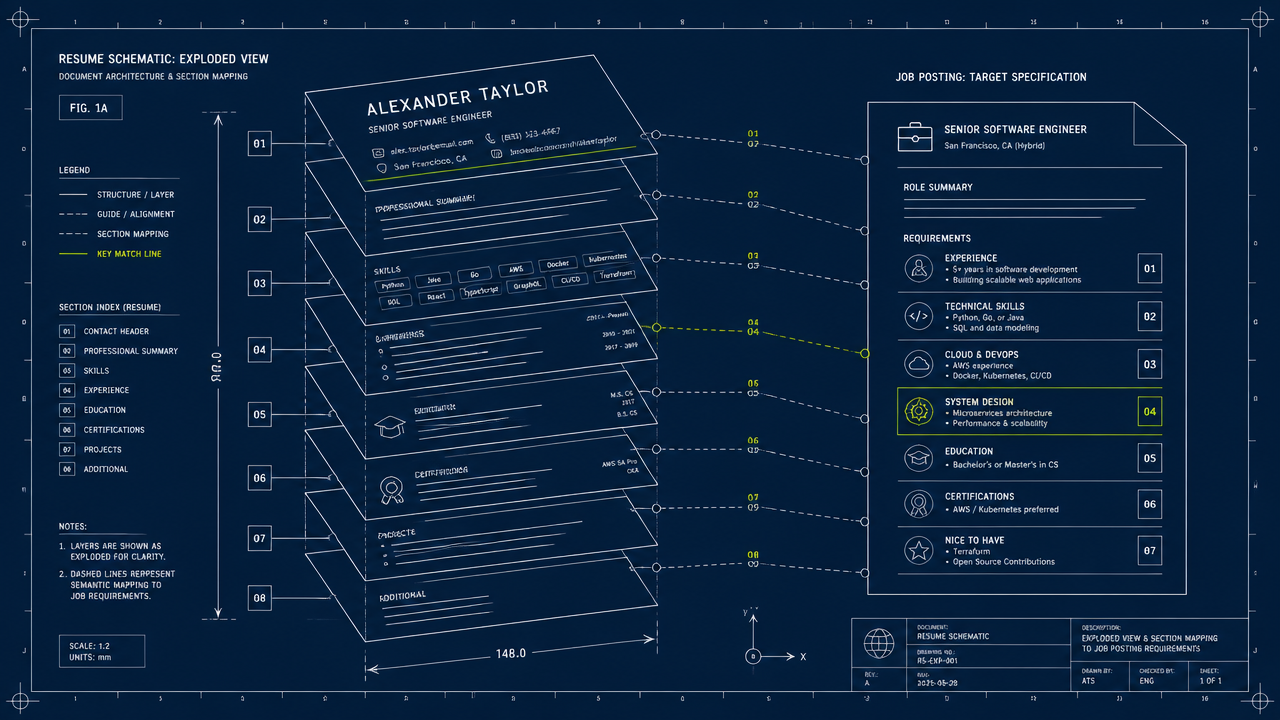
Yes. AI can tailor your resume to a specific job posting, and it's genuinely good at it — as long as you're clear about what "tailoring" actually means. AI is excellent at reading a job description, identifying the exact language an employer used, and rewriting your real experience so it lines up with that language. It is not capable of giving you experience you don't have, deciding whether you're a good fit for a team, or replacing the 60 seconds of human judgment you should spend before you hit submit. Most articles on this topic skip that second half. That's the half that determines whether the tailored resume works or gets you caught.
TL;DR
- AI is very good at keyword alignment, vocabulary mirroring, and reframing real experience toward a role.
- AI cannot invent credentials, judge fit, or know the unwritten context of the team. Anything that does is a liability.
- Generic ChatGPT tailoring fails on three things: no ATS scoring loop, cliché drift, and broken formatting on export.
- Good tailoring changes framing and emphasis. It never changes your titles, employers, dates, degrees, or certifications.
- The whole loop should take about 10 minutes per application. If it takes 45, you'll stop doing it by Thursday.
What AI Does Genuinely Well
Resume tailoring is, mechanically, a language-matching problem. That happens to be the exact thing large language models are best at. Five things AI does better than almost any human doing it manually at 11pm:
1. Keyword and phrasing alignment
Applicant Tracking Systems don't understand synonyms as well as people assume. A posting that says "stakeholder management" and a resume that says "worked with partners across the business" are describing the same work, but a keyword-matching filter scores them differently. AI reads the posting, extracts the terms that actually carry weight, and places them into your bullets where they're true. This is the single highest-leverage change and it's the one people most often skip. (More on which terms matter: ATS resume keywords for 2026.)
2. Mirroring the employer's vocabulary
Every company has a dialect. One calls them "clients," another "customers," another "accounts." One says "OKRs," another "goals." One says "SDLC," another "release process." Mirroring that dialect makes a resume feel like it was written for the role rather than forwarded to it — and human reviewers register that in the first few seconds, even if they can't articulate why.
3. Reframing existing experience toward the role
This is the part that surprises people. Most candidates are more qualified than their resume suggests, because their resume was written for a different job — usually the one they were applying to two years ago. AI is good at looking at a bullet about internal process documentation and recognizing that the posting cares about "enablement" and "knowledge management," then re-emphasizing that same work accordingly. Same facts, different lens.
4. Structure and parser hygiene
Multi-column layouts, text inside graphics, tables, headers in image form, creative section names — parsers mangle all of it. AI can flatten a resume into a structure that machines read cleanly while still looking normal to a person. See why ATS rejects resumes for the specific failure modes.
5. Speed, which is the actual unlock
Tailoring one resume by hand takes 30–45 minutes. Nobody sustains that across 40 applications. The reason AI tailoring matters isn't that it's better than a careful human editor on any single resume — it's that it's good enough, ten times faster, and therefore it's the version you'll actually do on application number 23.
What AI Does Not Do
Here's where honesty beats marketing. These are real limits, not modesty.
Hard limits
- It cannot give you credentials you don't have. No degree, certification, job title, employer, or year of experience should ever appear because a posting asked for it. If a tool does this, it isn't optimizing your resume — it's writing a document you'll have to defend in a screening call, on a background check, or after you're hired.
- It cannot judge whether you're a fit. AI will happily tailor your resume to a job you have no business applying to. A high keyword match on a role that's three levels above you produces an interview you lose, not a job you get.
- It doesn't know the unwritten context. That the role is backfilling someone who burned out. That the team is really hiring for SQL even though the posting leads with Python. That the hiring manager cares about one specific thing the posting never mentions. Humans learn that from a recruiter call or a conversation, not a JD.
- It won't sound exactly like you unsupervised. Left alone, models drift toward "results-driven professional with a proven track record of leveraging synergies." You have to read the output and cut anything you wouldn't say out loud.
- It cannot guarantee an interview. Tailoring improves the odds you're read by a human. It doesn't control headcount, internal candidates, timing, or budget freezes.
Where Generic AI Tailoring Breaks Down
"Can I just paste both into ChatGPT?" You can, and it's much better than sending the same resume everywhere. But three things go wrong consistently:
- No scoring loop. A general chatbot has no idea how well the output actually matches the posting. It rewrites, hands you something confident-sounding, and stops. There's no measurement, so there's no way to know if you improved or just moved words around.
- Quiet over-claiming. Ask a model to make your resume match a senior posting and it will nudge scope upward — "led" where you contributed, "owned" where you supported. It isn't lying maliciously; it's satisfying your instruction. You have to catch it.
- Formatting collapse. Chat output copied into Word arrives with stray markdown, inconsistent bullets, and broken spacing — the exact structural mess that causes parser problems in the first place.
None of these are reasons to avoid AI. They're reasons to review the output instead of trusting it.
What Tailoring Actually Looks Like at the Sentence Level
Abstract advice is useless here, so here's a concrete one. Say the posting is for a Customer Success Manager and it emphasizes churn reduction, onboarding, and cross-functional collaboration with Product.
Before
"Managed a book of 40 accounts, handled renewals, and worked with other teams to resolve customer issues."
After
"Owned onboarding and renewals for a 40-account portfolio, cutting churn from 14% to 9% over four quarters by partnering cross-functionally with Product to close the top three drivers of customer escalations."
Nothing was invented. Same accounts, same job, same work. What changed: the posting's actual terms are present, a real number was surfaced instead of buried, and vague "other teams" became the specific collaboration the employer said they care about. That's the whole game — and notice how much of it depends on facts only you know. Which is why the good version of this process asks you a couple of questions instead of guessing.
What Good AI Tailoring Looks Like in Practice
- A stated target role, not a claimed one. The clean way to signal intent is one line under your contact info —
Target Role: Customer Success Manager— instead of rewriting your last job title to match the posting. It gets the exact phrase on the page without misrepresenting your history. - Verbatim keyword matching where it's true. If the posting says "Salesforce" and you use Salesforce, the resume should say Salesforce — not "CRM platforms."
- Untouched history. Employers, titles, dates, degrees, certifications: off limits. Framing, verbs, ordering, emphasis, keyword density: fair game.
- A human pass before sending. Read it once, out loud. Delete anything you couldn't defend in an interview. This takes 60 seconds and it's the step that makes the difference.
A 10-Minute Per-Application Workflow
- Save the full job description text before it disappears. (~1 min — see why this matters.)
- Score your current resume against that posting so you know where the gaps are. (~1 min)
- Generate the tailored version against the exact JD text, not a summary of it. (~2 min)
- Answer any questions it asks about work that isn't on your resume yet. (~2 min)
- Read the output out loud. Cut clichés and anything you'd hesitate to defend. (~3 min)
- Export, confirm it's one clean column with no stray characters, and submit. (~1 min)
Ten minutes. Repeatable at application number 30, which is the only test that matters. More on the mechanics: how to tailor a resume fast.
Start with step 2: see where you actually stand.
Paste or upload your resume and the job description and get a match score with the specific keywords you're missing — free, in seconds, no account. If it needs the rewrite, a fully tailored resume is $5.
See My Score — Free →The Bottom Line
Can AI tailor your resume to a job posting? Yes — and it does the tedious, mechanical, high-impact part better and faster than you will by hand. What it can't do is give you a career you didn't have. The candidates getting real results from AI aren't the ones asking it to make them look like someone else. They're the ones using it to stop under-selling what they've already done, one posting at a time.
Use it as leverage on true material. That's where all of the upside is, and none of the risk.