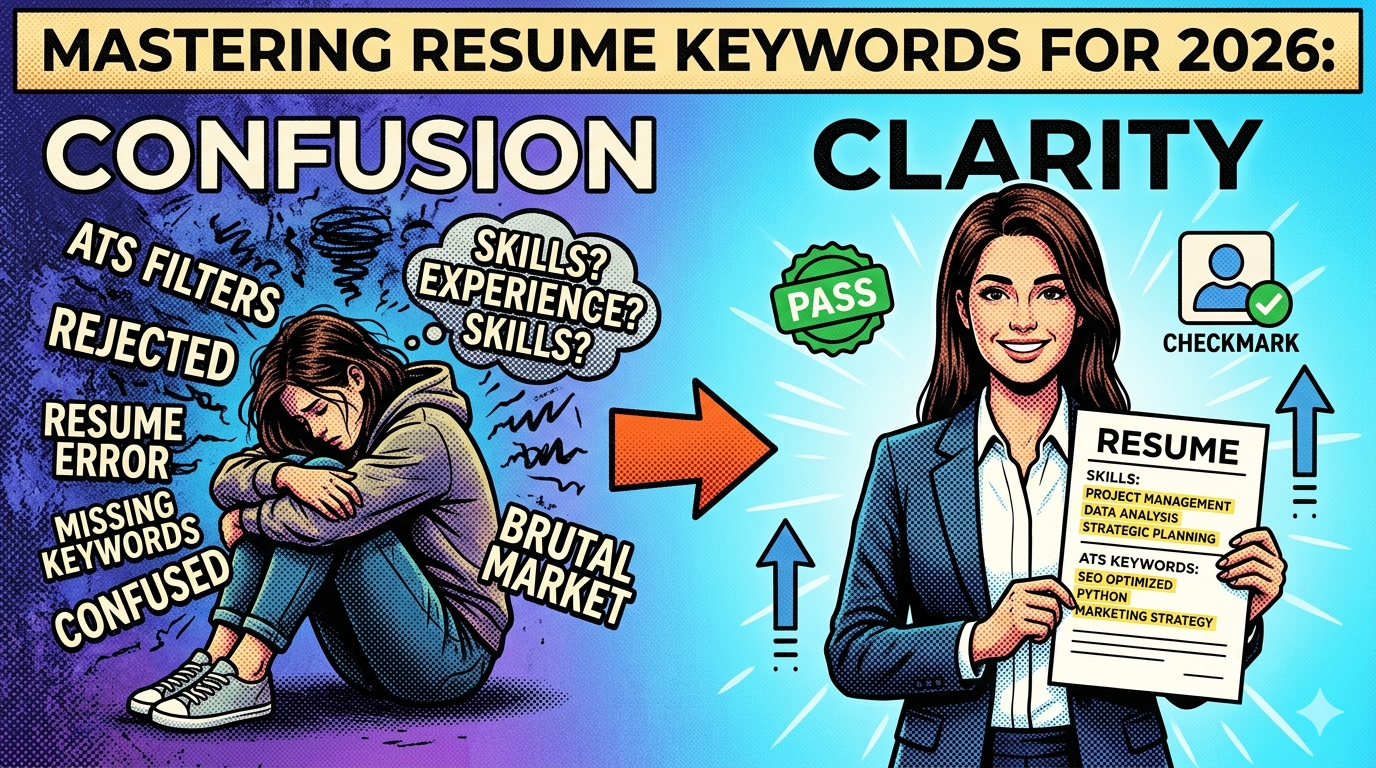
Search "ATS resume keywords" and you'll find a hundred lists telling you to sprinkle words like "results-driven," "team player," and "synergy" into your resume. Those lists are worse than useless — they're actively hurting your chances. The right keywords for your resume are not on a generic list. They're in the job description you're applying to right now.
This guide explains how ATS keyword matching actually works in 2026, which keywords matter, which are noise, and how to extract the right ones from any posting in under five minutes.
TL;DR
- Generic keyword lists are obsolete — modern ATS scoring is per-posting.
- The keywords that matter are nouns: tools, certifications, methodologies, job titles.
- Soft-skill buzzwords ("team player," "self-starter") are scoring noise.
- Keyword density matters less than keyword presence in the right sections.
How Keyword Matching Actually Works in 2026
Older ATS software (think: 2015-era Taleo) did simple string matching. If the job said "JavaScript" and your resume said "JavaScript," you scored a point. If your resume said "JS," you scored zero. Crude, but predictable.
Modern ATS platforms — Greenhouse, Lever, Workday, iCIMS in their current versions — layer natural language understanding on top of that string matching. They recognize common synonyms ("JavaScript" ≈ "JS"), they weight context (a skill mentioned in your work history scores higher than the same skill in a "skills" list), and they penalize obvious keyword-stuffing.
Practically, this means three things:
- You still need the exact keywords from the JD — synonyms only get you partial credit.
- Keywords inside accomplishment bullets count more than keywords in a "skills" dump.
- Stuffing the same word ten times no longer helps and can flag your resume as spam.
The 4 Types of Keywords That Actually Matter
1. Hard Skills and Tools
Specific software, programming languages, frameworks, platforms. These are the highest-signal keywords because they're the easiest for the ATS to verify and the easiest for a recruiter to filter on.
Examples: Salesforce, Python, React, Figma, HubSpot, Tableau, AWS, Kubernetes, QuickBooks, SAP.
How to use them: Verbatim. If the JD says "Power BI," don't write "Microsoft BI tools." Write "Power BI."
2. Certifications and Credentials
These are binary — you either have them or you don't, and the ATS treats them as non-negotiable filters when listed as "required."
Examples: PMP, CPA, CFA, AWS Solutions Architect, Salesforce Certified Administrator, SHRM-CP, Series 7, Six Sigma Black Belt.
How to use them: Use the exact acronym and the spelled-out name in the same line. ATS parsers index both.
3. Methodologies and Frameworks
How you work, not just what you use. Important for technical, operational, and management roles.
Examples: Agile, Scrum, Kanban, Lean, Six Sigma, OKRs, SAFe, DevOps, CI/CD, GAAP, IFRS, HACCP.
How to use them: Inside accomplishment bullets, not in a separate list. "Led Agile sprint planning for a team of 12" beats "Skills: Agile."
4. Standardized Job Titles
Recruiters search by previous title. If your last role was "Customer Happiness Hero" but the JD is for a "Customer Success Manager," translate.
How to use them: Use the standard industry title. If your real internal title was different, you can include it in parentheses: "Customer Success Manager (internal title: Happiness Hero)."
ATS Keywords List: 60 Real Examples by Category
Every generic "top ATS keywords" list is a trap, but examples help you recognize the shape of a real keyword. Here's an ATS keywords list organized the way an ATS actually scores them — hard nouns, credentials, methods, and titles. Use it as a pattern library, then pull your actual keywords from the posting in front of you.
Software and platforms
Salesforce, HubSpot, NetSuite, SAP, Workday, QuickBooks, Jira, Confluence, Tableau, Power BI, Looker, Snowflake, Google Analytics 4, Marketo, Zendesk, Epic, Workfront.
Technical skills
Python, SQL, JavaScript, TypeScript, React, Node.js, Java, AWS, Azure, Kubernetes, Docker, Terraform, CI/CD, REST APIs, ETL, dbt, Git.
Certifications and credentials
PMP, CAPM, CPA, CFA, Series 7, SHRM-CP, PHR, CISSP, Security+, CompTIA A+, AWS Solutions Architect, Salesforce Certified Administrator, Six Sigma Black Belt, RN, CSM (Certified ScrumMaster).
Methodologies and frameworks
Agile, Scrum, Kanban, SAFe, Lean, Six Sigma, DevOps, OKRs, GAAP, IFRS, SOX, HIPAA, GDPR, ISO 9001, HACCP.
Standardized job titles
Account Executive, Customer Success Manager, Business Development Manager, Product Manager, Program Manager, Data Analyst, Financial Analyst, Operations Manager, Software Engineer, Marketing Manager, HR Business Partner, Revenue Cycle Specialist.
Notice what's missing: adjectives. Every entry above is a noun a recruiter could filter on. That's the test for whether something belongs on your resume as a keyword.
The Keywords That Don't Matter (And Hurt You)
Generic soft-skill buzzwords are the junk food of resume writing. They feel like keywords, but they don't move the score and they waste line space that could hold real signal.
Avoid filling your resume with: team player, self-starter, results-driven, hard-working, detail-oriented, motivated, dynamic, passionate, synergy, leverage (as a verb), thought leader, rockstar, ninja, guru.
These words don't fail you, but they don't pass you either. And every line spent on them is a line not spent on a hard keyword that would.
How to Extract the Right Keywords From Any Job Posting
Here's the process, stripped down:
- Copy the entire JD into a plain text file. Strip the company boilerplate ("we're a fast-growing startup...") — that's not where keywords live.
- Highlight every concrete noun in the requirements section. Tools, certifications, methodologies, technologies. Ignore adjectives.
- Highlight every verb attached to a measurable outcome. "Built," "led," "scaled," "reduced," "automated." These are the verbs your bullets should mirror.
- Cross-check against your resume. Every highlighted noun you legitimately have experience with should appear at least once, ideally inside a bullet that shows you used it to deliver a result.
- Don't stuff what you don't have. Lying about a certification or tool is the fastest way to get caught in the interview and blacklisted.
Manually, this takes 20–40 minutes per job. If you're applying to 15 roles a week, you're looking at 5–10 hours of keyword work alone. That's why we built an AI-powered ATS optimizer that does this analysis in about 60 seconds — paste your resume, paste the JD, get back a rewritten version with the right keywords already woven in. Or start with a free ATS resume check to see which keywords you're missing, or check your Job Match Score to see how the whole resume stacks up.
Where Keywords Should Live in Your Resume
Position matters as much as presence. From highest signal to lowest:
- Professional summary (top 3–4 lines). The most-scanned section by both ATS and recruiters. Include 2–3 of the most critical keywords here.
- Inside work experience bullets. Highest contextual weight. A keyword here proves you've actually used the skill.
- Job titles. Standard industry titles only.
- Skills section. Lower weight than bullets, but still useful as a catch-all for hard skills you can't naturally fit into work history.
- Certifications section. Critical for any keyword that's a credential.
Want to see what good keyword placement looks like in practice? Our guide on how AI can tailor your resume to a job posting walks through a real before/after at the sentence level.
See which keywords you're missing — free.
Paste your resume and the job description and get a free Job Match Score with the keyword gaps called out. No account, no card. If you want the rewrite that fixes them, it's $5.
Get My Free Match Score →The Bottom Line
There is no magic list of keywords that works for every job. The keywords that get your resume past this ATS are sitting in this job description. Your only job is to find them, prove you have the experience behind them, and put them in the right places.
Do that, and the algorithm starts working for you instead of against you.