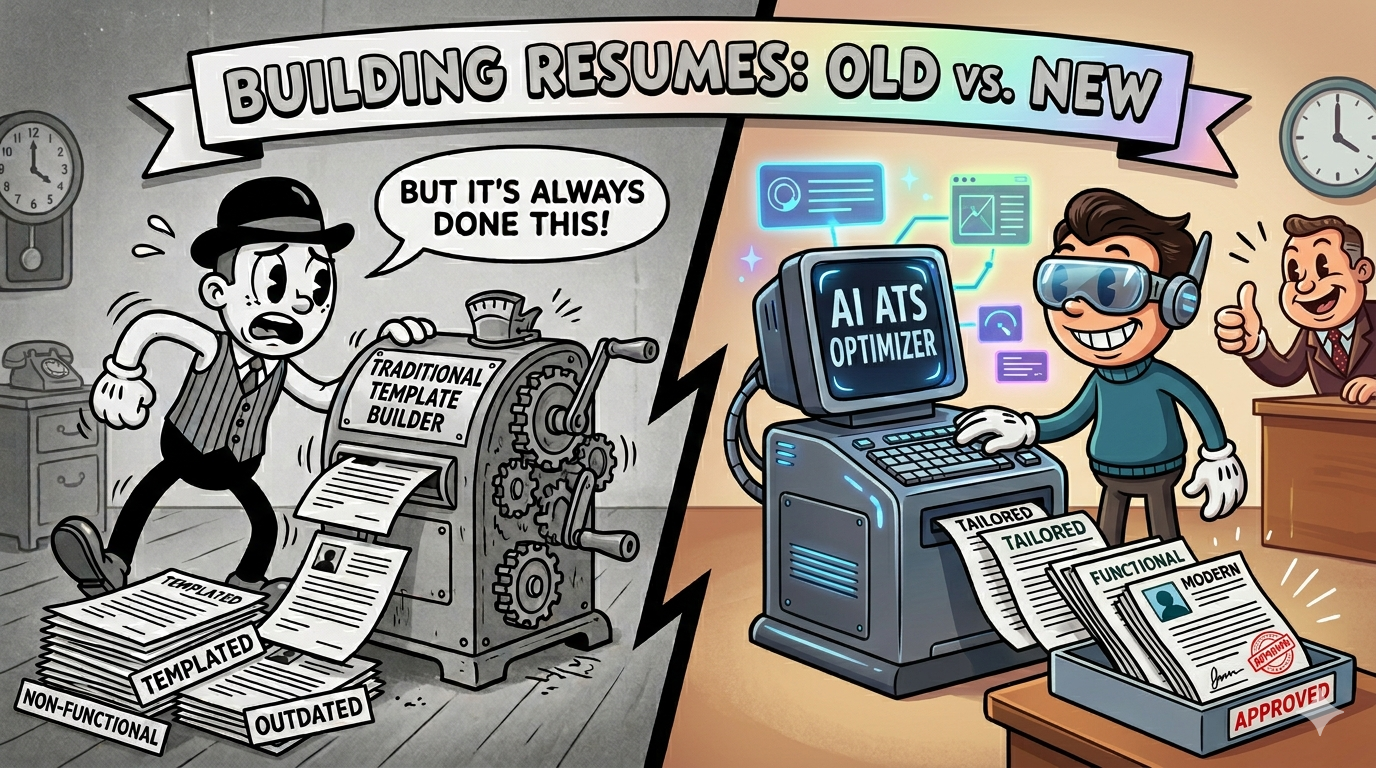
Resume builders are a billion-dollar industry. So why do most candidates still hear nothing back? Because the standard "resume builder" solves the wrong problem. It gives you a tidy template — fonts aligned, bullets indented, sections labeled — and then leaves you to write the same generic resume you would have written in Word, just prettier. An AI resume optimizer flips that model: instead of a blank template to fill in, it rewrites the resume you already have to match the specific job you're targeting.
ResumeAgent isn't a template. It's a strategist. Here's the honest comparison between the two approaches, where each one wins, and which one actually gets you interviews in 2026.
TL;DR
- Traditional builders solve formatting. AI resume optimizers solve relevance.
- One template + one resume = one rejection per job.
- ResumeAgent rewrites your resume against the actual job description in seconds.
- $10 once, no subscription, no account, ATS-clean DOCX out the other side.
What Traditional Resume Builders Actually Do
To be fair: template-first builders did a real job for a long time. They took people out of Word's tab-and-table hell and gave them clean, sectioned layouts they could fill in. The good ones offer:
- Pre-designed templates with consistent typography and spacing
- Drag-and-drop section reordering
- One-click PDF or DOCX export
- Generic content suggestions ("try: 'led a team of 5'")
- Cloud storage so you can edit from any device
If you've never written a resume before and you need something that doesn't look like it was made in 2003, a template builder is a reasonable starting point. But that's where their usefulness ends.
Where Traditional Builders Fall Apart
1. One resume for every job
Templates don't know what job you're applying for. The resume you build on Monday for a product role is the same resume you send Friday for a program management role. That's exactly the resume recruiters and ATS scanners are trained to ignore.
2. Designs that ATS systems silently reject
The most popular templates are also the most ATS-hostile: two-column layouts, sidebars, icons, photos, custom fonts, text inside graphics. Your resume looks great to you and gets parsed as nonsense by the system that decides whether a human ever sees it. We covered this in detail in why ATS rejects most resumes.
3. Content suggestions that aren't really suggestions
"Try this bullet: 'Increased revenue by X%.'" That's not writing assistance — that's a Mad Lib. It can't tell you which of your accomplishments matter for this specific job, because it doesn't know either.
4. The subscription trap
Many builders are free to use until you actually want to download your resume. Then it's $24.99/month, auto-renewing, with a deliberately buried cancellation flow. You needed a resume, not a streaming service.
5. Account, account, account
Email, password, marketing consent, "verify your inbox," upsell modal, onboarding tour. All before you've typed a single bullet point. Then your resume sits in their database forever.
What An AI Resume Optimizer Does Differently
An AI resume optimizer skips the template-and-fill-in-the-blanks model entirely. You bring two things: the resume you already have, and the job description you're applying to. An AI resume optimizer does the rest:
- Reads the job description and identifies the keywords, responsibilities, and signals the ATS and recruiter actually care about.
- Asks targeted discovery questions when your resume is missing something the job specifically asks for — so you can fill the gap with real experience instead of inventing it.
- Rewrites your resume to surface the most relevant accomplishments, mirror the job's language, and quantify impact where it matters most.
- Outputs ATS-clean DOCX and PDF — no two-column layouts, no graphics, no parser-breaking flourishes.
- Generates a matching cover letter in the same flow, tied to the same resume and job. (More on the cover letter formula here.)
- One payment, no account, no stored resume. You pay once, you download, you're done.
Side-by-Side
| Traditional Resume Builder | ResumeAgent | |
|---|---|---|
| Approach | Template + you fill it in | AI rewrites for the specific job |
| Tailored per job | No — same resume every time | Yes — every output is JD-specific |
| ATS-friendly output | Often no (columns, icons, graphics) | Yes — clean single-column DOCX/PDF |
| Cover letter | Separate tool, generic templates | Matched to the same resume + JD |
| Pricing | $15–$30/mo subscription | $5 or $10, one-time |
| Account required | Yes, with marketing emails | No account, ever |
| Time to result | 30–60 min of manual editing | ~60 seconds |
When a Traditional Builder Still Makes Sense
We're not going to pretend template builders have zero use cases. Use one when:
- You're writing your first-ever resume from a blank page and need a structural starting point.
- You're applying for a visual or design-heavy role where the recruiter is the only filter and an aesthetic resume is part of the portfolio.
- You want to print physical copies for a job fair and presentation matters more than ATS compatibility.
When ResumeAgent Is the Right Call
Pretty much every other scenario:
- You already have a resume and you're applying to multiple jobs.
- Your applications are going through an ATS (which is most of them — Workday, Greenhouse, Lever, iCIMS, Taleo).
- You're tired of getting silence and want to actually beat the keyword filter.
- You want a cover letter that doesn't sound like ChatGPT wrote it from scratch.
- You don't want another monthly subscription on your card.
The Bottom Line
Traditional resume builders solved a 2010 problem: making resumes look professional. The 2026 problem is different. Recruiters get hundreds of resumes per role. ATS filters reject the majority before any human reads them. What gets you through isn't a prettier template — it's a resume that visibly matches the job in front of it. That's exactly what an AI resume optimizer is built to produce: a resume tuned to the job, not just dressed up for a template.
Templates format. ResumeAgent strategizes. That's the whole difference.
Stop reformatting. Start with your score.
Drop your resume and the job description and get a free Job Match Score in seconds — no account, no card. The ATS-friendly, JD-tailored rewrite is $5 if you want it.
See My Score — Free →