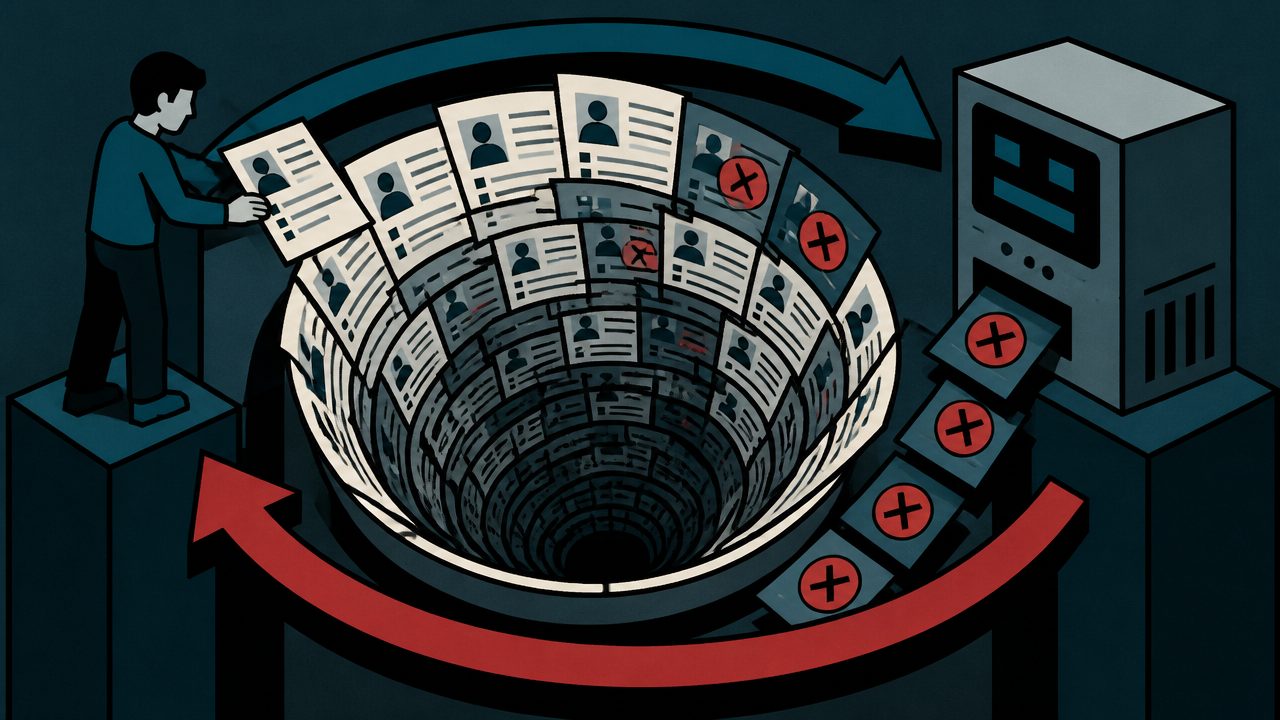
A Benzinga piece syndicated on Yahoo Finance last week carried a headline that captures the moment perfectly: "Job Seekers Are Using AI to Apply Everywhere, Recruiters Are Using AI to Filter Them — Greenhouse CEO Calls It a 'Doom Loop.'" Greenhouse CEO Daniel Chait is right that the market is broken. He's right that both sides are miserable. But the story he tells about how we got here — and the product he offers as the way out — deserve a much harder look than the article gives them.
TL;DR
- Employers automated hiring decades before job seekers had AI. The loop started on the employer side.
- The "5.8x more likely to be hired" Dream Job stat is textbook selection bias, not a controlled result.
- Dream Job's real function is data capture: candidate profiles for the people who actually pay Greenhouse.
- The genuinely useful numbers: 254 applicants per posting, +412% applications per recruiter.
- Using AI isn't the sin. Sending something that reads like it wasn't written by a person is.
1. The Loop Didn't Start With Job Seekers
The article's framing is causal and it's backwards: candidates started spraying AI applications, recruiters got buried, recruiters deployed AI to cope, candidates escalated. Job seekers are the first mover in that story. That doesn't survive contact with the timeline.
Applicant Tracking Systems have been screening résumés since the 1990s. Keyword parsing, knockout questions, auto-rejection rules, scored candidate rankings — all standard employer practice long before a job seeker could buy an auto-apply tool for $20. Greenhouse itself was founded in 2012. LinkedIn's "Easy Apply" — the single largest accelerant of low-friction mass applications — was an employer-side product decision, shipped by a platform whose customers are recruiters, not candidates.
There's a structural reason it went in that order. Enterprises are the first customers of essentially every new business technology, because they're the most lucrative customers: they have budgets, procurement teams, and a per-seat justification for anything that cuts headcount cost. Consumer-grade tools arrive later and cheaper. That's why HR departments had résumé-parsing software for twenty years before an individual job seeker had anything remotely comparable.
So the honest sequence looks more like this: employers automated screening → the rejection rate became opaque and enormous → candidates rationally responded to a black box by increasing volume → AI made increasing volume nearly free. Candidates didn't open the loop. They were the last party to get the technology and the first party to be blamed for using it.
This isn't a semantic quibble. Whoever is cast as the cause becomes the target of the remedy. Frame candidates as the origin, and every "fix" is a new hoop for candidates to jump through. Frame employer automation as the origin, and the fix looks like employers publishing salary bands, closing dead requisitions, and actually replying to people. Notice which kind of fix the article proposes.
2. "My Dream Job" Is an Editorial Ad Wearing a Press Release
The piece's "Greenhouse Fix" section reports that candidates who flag one job per month as their Dream Job get hired at roughly five times the rate of everyone else. Greenhouse's own marketing goes further: 5.8x more likely to be hired, hired in 20.5 days versus 35–50, moving through the pipeline 4x faster.
Those numbers compare people who chose to use the feature against everyone who didn't. That's not a controlled comparison. It's a self-selected group measured against a pool that includes the exact mass-application spam the feature was allegedly built to solve.
Who actually flags a Dream Job?
Someone who created a MyGreenhouse account, completed a profile, tracked which applications matter most to them, and deliberately spent their one monthly credit on a specific role. That person was already running a better job search than average — more targeted, more prepared, far more likely to have tailored their résumé. The flag is a marker of a strong candidate, not the cause of their outcome.
To make a causal claim, Greenhouse would need to compare Dream Job users against a matched cohort of equally engaged candidates who didn't use the flag — same tailoring behavior, same application volume, same seniority, same market. They haven't published anything like that. Until they do, "5.8x more likely to be hired" tells you about the population that opted in, not about the effect of opting in.
Follow the incentives
Dream Job's most valuable output for Greenhouse isn't candidate happiness — it's data. The feature converts anonymous applicants into registered MyGreenhouse users with structured, self-reported intent profiles. That's stickier candidate-side engagement and a cheap new signal to offer the people who actually pay Greenhouse: employers.
Greenhouse president and co-founder Jon Stross has described the feature as helping employers "identify high-intent candidates." Read that sentence again and note who is centered in it. The candidate benefit is real but downstream of the business case: give recruiters a cheap filter, and give candidates a reason to build a profile.
What's probably true, narrowly
Recruiters likely do treat a Dream Job tag as a weak positive signal — something like a very soft referral. Glancing at a filtered "priority candidates" list first is nearly free for them. If you're already strong enough to survive a real read, flagging your genuine top choice probably doesn't hurt and might get you into the first pass.
It will not turn a weak application into a 5.8x-better one. And you get one credit a month, so it isn't a lever you can pull at volume. Practical rule: if a role you actually want is hosted on Greenhouse and it genuinely is your top choice that month, flag it — one click, no downside. Just don't mistake the marketing stat for a mechanism.
3. The Three Numbers Actually Worth Your Attention
Buried in the same article are the most useful facts in it, and they get one sentence:
175,000
live jobs on Greenhouse
254
average applicants per posting
+412%
growth in applications per recruiter
Sit with 254 applicants per posting. If a recruiter gives each application even fifteen seconds, that's an hour of pure screening per requisition — and they're carrying dozens of requisitions while applications per recruiter have more than quintupled. No human reads 254 résumés carefully. They read the ones the system surfaces, in the order the system surfaces them, and they stop when they have four or five people worth a call.
Two operational conclusions follow directly:
- The keyword layer is not optional. If your résumé doesn't match the job description's language, you are never in the pile a human sees — no amount of quality rescues you from a rank you never earned. That's the entire reason ATS filters reject qualified people.
- Timing is leverage. Applicant 8 of 254 gets read differently than applicant 200, because the shortlist is often full by then. This is why applying within the first 48 hours measurably changes your odds.
4. On Anne Hathaway and the "AI Tell"
The article closes with actress Anne Hathaway warning candidates off ChatGPT-written thank-you notes after receiving a batch of suspiciously similar messages during a hiring process: "If you're out there thinking that you're getting away with something, there's a chance that you might be revealing yourself."
She's identifying a real failure mode and drawing the wrong conclusion from it. What she received wasn't the smell of AI — it was the smell of unedited default output. Every one of those notes read the same because every one of those candidates pasted a prompt, copied the first answer, and hit send. The tell isn't the tool. The tell is the absence of a person in the final draft.
It's also worth naming the asymmetry. The employer side of this process is allowed to use AI to parse, rank, score, and now voice-interview candidates at scale — Greenhouse acquired Ezra AI Labs specifically to run AI voice interviews, and Amazon shipped Connect Talent to screen and interview automatically. The candidate side gets told that using AI to save time on a thank-you note is a moral failure. Both sides are automating. Only one side gets lectured about authenticity.
The workable standard is simple, and it's the same one we apply to our own product:
Use AI to find the right words for things that are true. Never to invent a title, employer, degree, certification, or result you don't have. Then read it out loud. If it doesn't sound like you talking, rewrite the lines that don't — usually it's the opening and closing sentences doing the damage.
That's exactly how the direct email to the hiring manager should work: AI drafts the structure so you actually send it, and you supply the specific detail — the product you noticed, the number from your own work, the reason this company and not the other 253 — that no model could have generated for you.
5. Yes, Referrals Still Win — For the People Who Have Them
The single most reliable path into a company remains a warm internal referral. That's been true for decades and AI hasn't dented it; if anything, 254 applicants per posting makes a trusted human vouch more valuable than ever.
But "get a referral" is advice that quietly assumes a network that already overlaps with the companies you want. For most people, on most openings, there is nobody to ask. Telling job seekers the best channel is one they can't access isn't guidance, it's a description of an advantage they don't have.
The realistic move is to build the closest available substitute: a résumé that ranks in the automated pass, plus one direct, specific, human message to the person who owns the requisition. That combination is the manufactured version of a referral — it produces the same effect, a named human deciding you're worth a look, without requiring a friend on the inside. Our guides on finding the hiring manager and tailoring per application cover both halves.
6. What the Article Left Out
A few things go unmentioned that matter more than Dream Job:
- Ghost jobs. A meaningful share of those 175,000 live postings aren't hiring — they're pipeline-building, budget placeholders, or compliance postings for roles already filled internally. Candidates are told to apply more thoughtfully to requisitions that were never real. That's not a candidate behavior problem.
- Rejection opacity is what drives volume. When you receive no response, or a templated rejection twelve seconds after applying, you learn nothing and can only rationally respond by applying to more places. Give candidates a reason and the volume drops. The doom loop is fed by silence.
- Requisition hygiene. Six-round loops, 15-requirement JDs for mid-level roles, and postings left open for months generate applicant floods on their own. No candidate-side feature fixes an employer-side process problem.
- The vendor is on both sides of the loop. Greenhouse sells the screening automation that contributes to the flood, and now sells the intent signal that helps recruiters navigate the flood. Diagnosing a problem you profit from at both ends warrants a skeptical read — which is what a news article, rather than a syndicated business-wire piece with affiliate links, would have provided.
254 applicants. One of them gets read first.
You can't opt out of automated screening, and you can't out-volume it. You can find out whether your résumé actually matches the posting. Paste your résumé and the job description and get a free Job Match Score in seconds — no account, no card. If you want the rewrite afterward, it's $5.
Score My Resume Free →The Bottom Line
Chait's diagnosis is right and his history is wrong. Hiring is genuinely broken, and both sides genuinely hate it. But the automation started with the side that had the budget, and the escalation on the candidate side was a rational response to a black box, not the original sin.
Be appropriately skeptical when the company that sells the screening layer identifies the problem as you, and then offers a free feature that happens to require you to hand over a profile. Flag your dream job if you have one — it's one click. Then go do the two things that actually move the number: rank in the automated pass, and put one genuinely human message in front of the person doing the hiring.
Fight fire with fire. Just make sure it still sounds like you.